Embedded
Bring AI directly into Control Hub. Use collaboration data and administrative context to help people understand their environment, troubleshoot issues, and move from recommendations to plans and action.
INTELLIGENCE WITHIN THE PRODUCTMoving enterprise administration beyond a read-only assistant toward AI that can help admins understand, plan, and safely act—with clear boundaries for authority, confirmation, and execution.
AI Strategy Lead / AI UX Lead
Admin workflows, agentic UX & governance
Strategy, research & prototypes
Cisco AI Assistant could help administrators find and understand information, but the experience stopped at read-only guidance. It could not take action on an admin’s behalf.
That limitation mattered in Control Hub, where the difficult part of administration is often not finding an answer—it is understanding the right scope, making a change safely, and knowing what will be affected before committing it.
I led the experience strategy for what should come next: an agentic administration model that could support real administrative work while preserving enterprise trust, governance, and control.
How might AI help an administrator move from understanding a problem to safely completing the work—without hiding scope, authority, or consequences?
The starting point was Cisco AI Assistant (CHAI): useful for questions and discovery, but not designed to complete administrative actions.
CHAI also asked admins to explicitly add context before asking a question. In testing, that interaction performed very poorly. Categories such as configurations, data, reports, and workspaces overlapped conceptually, forcing users to understand our information model before they could ask for help.
That surfaced a more fundamental experience problem: the assistant was asking the admin to do the work of deciding what context mattered. For a future agentic experience, context needed to become something the system could understand and communicate—not another configuration task for the user.
A better AI experience could not simply add write actions to the existing chatbot. We needed to rethink context, planning, authority, confirmation, and traceability as one administrative workflow.
That insight shaped the strategy. Instead of treating AI as a destination or asking admins to manually assemble context, I defined a model in which AI supports the administrative task across the surfaces where work already happens.
My current playbook defines two surfaces: embedded AI inside Control Hub and extended capabilities in external agents. The hybrid model describes the handoff between them, with a shared approach to authority and oversight.
Bring AI directly into Control Hub. Use collaboration data and administrative context to help people understand their environment, troubleshoot issues, and move from recommendations to plans and action.
INTELLIGENCE WITHIN THE PRODUCTBring Control Hub capabilities into external AI platforms. External agents can explain, investigate, and recommend through MCP and MCP Apps. Consequential actions cross-launch to Control Hub for confirmation and execution.
CAPABILITIES BEYOND THE PRODUCTConnect both models. Allow work to move between Control Hub and external AI systems while preserving governance, trust, and visibility.
CONTROL ACROSS EVERY SURFACEThe future was not a choice between Embedded and Extended. It required both, with a consistent approach to enterprise oversight.
Yankun Wang set up the working prototype and led its design and implementation. The team used it to explore the shift from a read-only assistant toward realistic administrative workflows: understanding context, recommending actions, creating plans, and safely executing work.
The prototype made the before-and-after tangible. Rather than requiring the admin to choose overlapping context categories and stop at an answer, the future-state model explores how the system can reason over administrative context, explain its plan, and preserve human control before consequential actions.
The prototype supported stakeholder discussions, design reviews, and alignment around future roadmap investments. It was an exploration tool, rather than a production-ready design.
Defined the framework and future vision, created the Agentic UX playbook site, and guided reviews and stakeholder alignment. Shared guidelines were authored by a colleague.
Set up the prototype and led its design and implementation. Primary credit for the functional prototype belongs to Yankun, including the foundation used for these agentic workflow explorations.
Unlike conventional software, agentic applications can evolve, gain capabilities, access tools, and act on behalf of users. We researched enterprise administrators, collaboration engineers, and developers to understand the mental models and governance needs this introduced.
I synthesized research findings and customer feedback into governance strategy, UX concepts, and administrative workflows.
Participants struggled with terms such as tools and schemas. They wanted to know what an app could do, which systems it could access, and which actions it could perform.
Design direction: Translate technical structures into capability-based explanations of outcomes and risk.
Administrators wanted to understand what changed after deployment, which capabilities were added, and what new risks they were accepting.
Design direction: Surface meaningful differences through change-review and approval workflows.
Enterprise rollout needs extended beyond individual users. Participants expected pilot groups, staged rollouts, bulk permissions, and organization-wide governance.
Design direction: Support validation before broad deployment through scalable access and rollout controls.
Administrators needed to know who owned an application, who supported it, where documentation lived, and who was responsible for approvals.
Design direction: Make organizational responsibility part of the management experience.
I created an internal Agentic UX playbook to make the strategy usable by design, product, engineering, and platform teams.
I authored the strategy, audience framing, experience specifications for PM-defined use cases, audit and traceability model, and reusable skill packaging, and created the site that brings them together. The shared guidelines were authored by a colleague; I incorporated them into the playbook with that contribution distinguished from my own.
The shared workflow moves from understanding the goal and scope, to deciding on a plan, acting with the right authority, and returning a result the admin can verify.
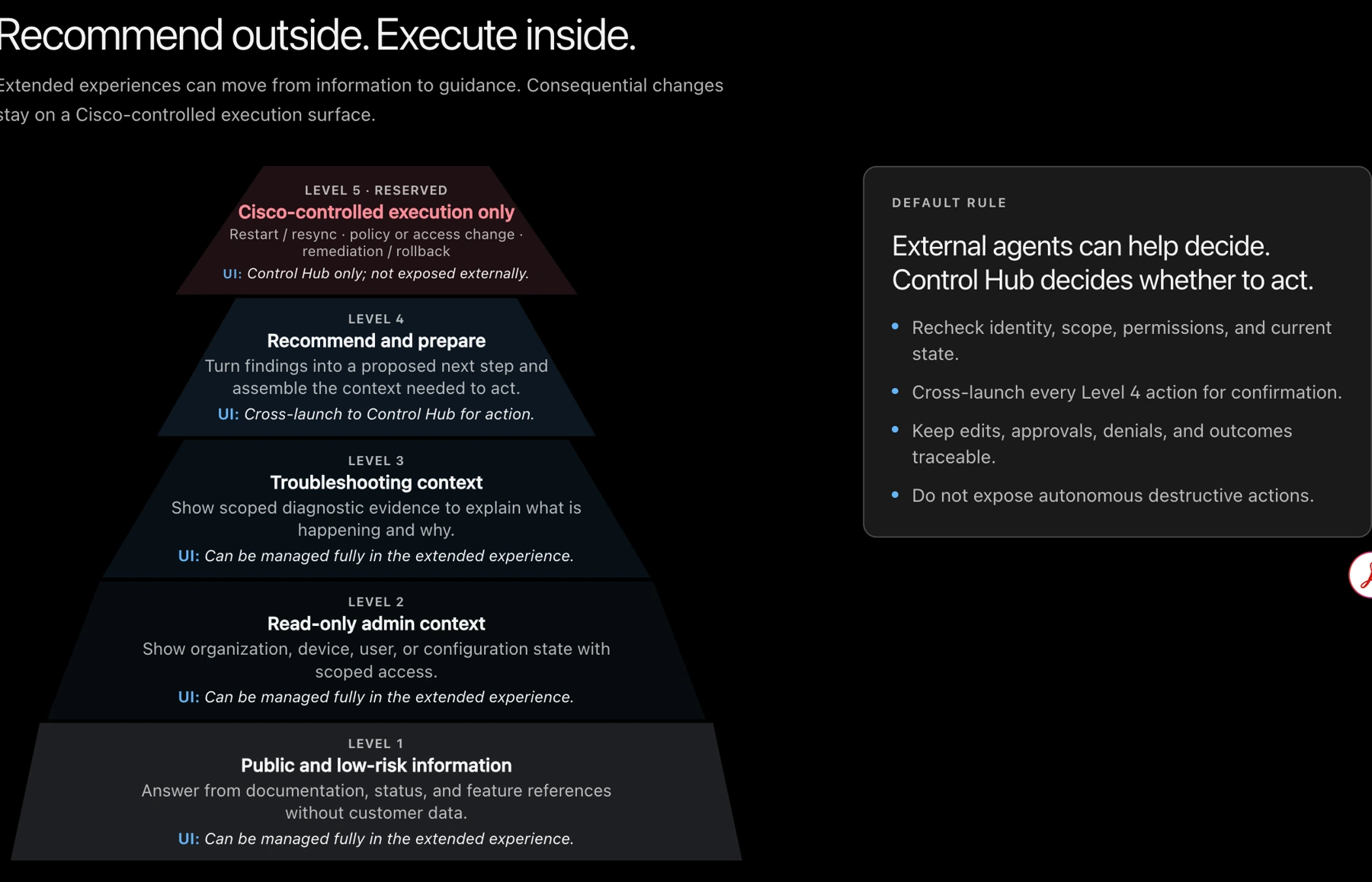
I organized extended capabilities into five levels: public information, read-only admin context, troubleshooting, recommendations and preparation, and reserved execution. External experiences can support understanding and preparation. Changes such as restart, policy edits, access changes, remediation, and rollback remain on a Cisco-controlled surface.
Before action, Control Hub rechecks identity, scope, permissions, and current state. The experience keeps edits, approvals, denials, and outcomes traceable.
PM outlined three administrative use cases: compare, clone, and understand dependencies. I used those use cases to make the agentic model concrete in the playbook’s experience specifications.
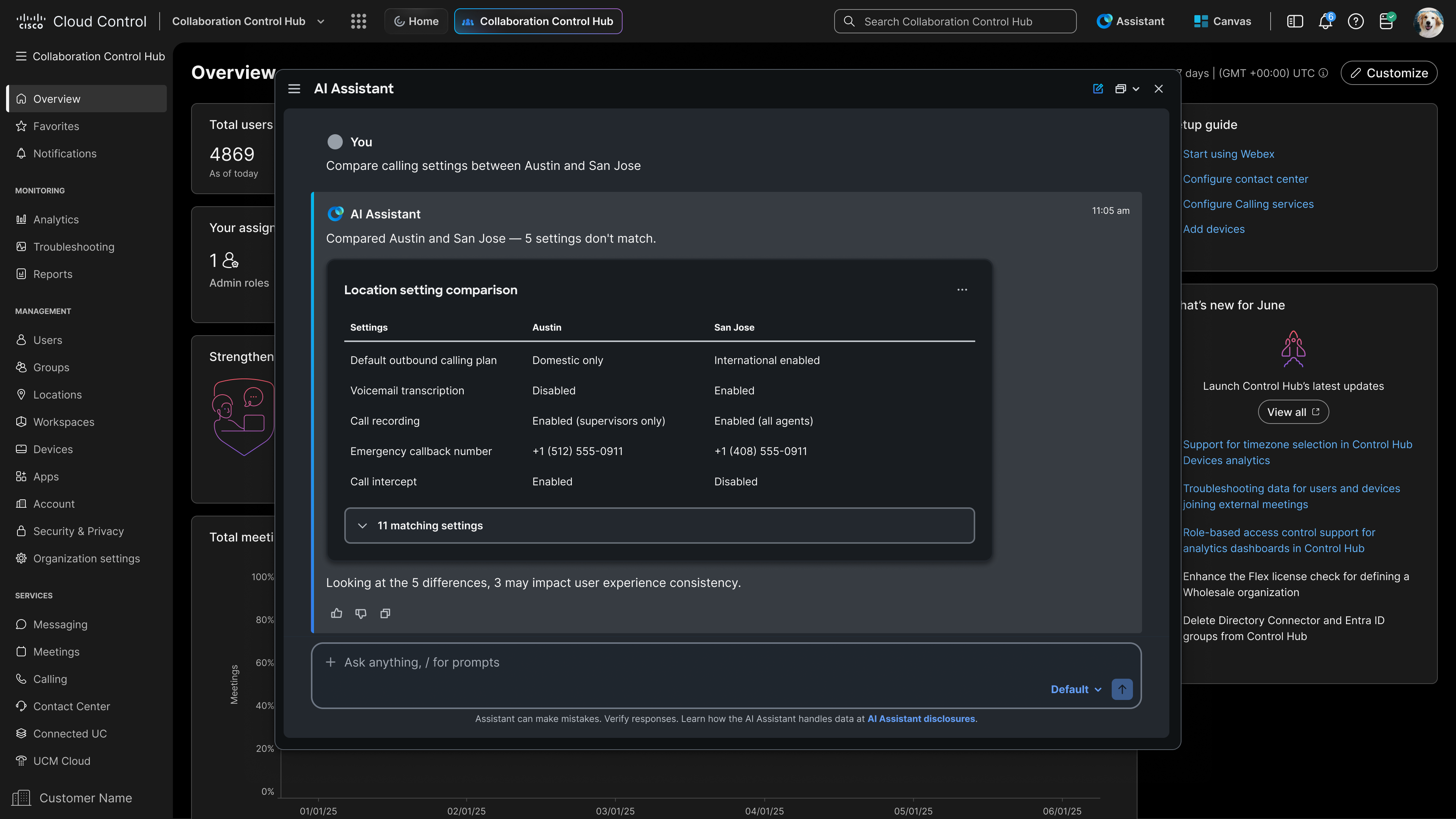
The comparison example below shows an admin asking about calling settings in Austin and San Jose. The assistant separates five differences from eleven matching settings and highlights differences that may affect user experience consistency, helping the admin understand the configuration before deciding what to change.
This is a draft experience specification, not a released feature or a measured user outcome.
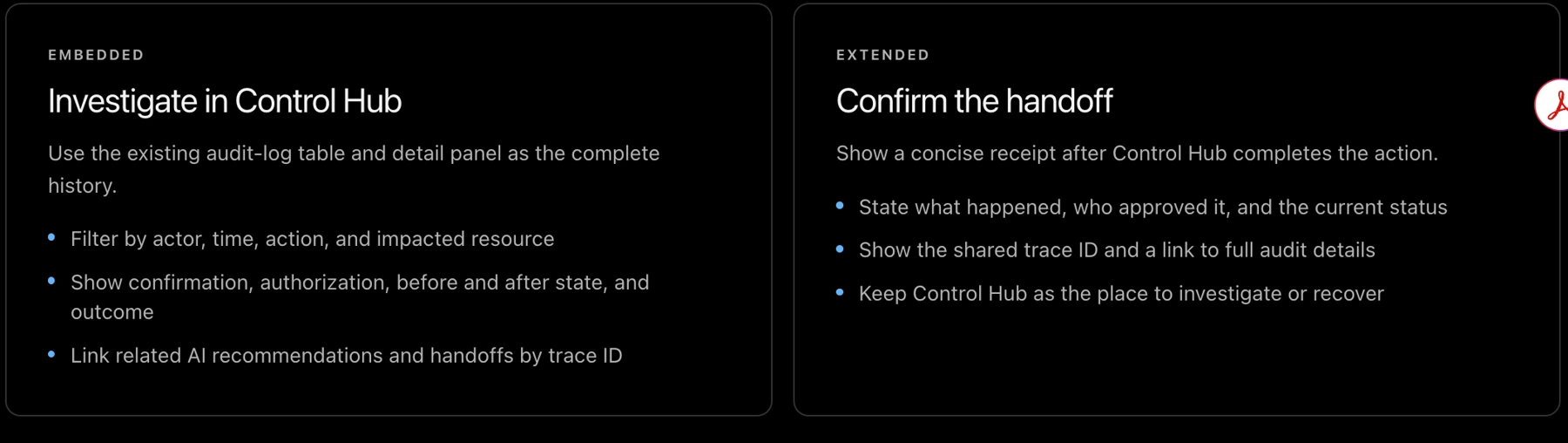
I defined a shared audit model that captures who requested, approved, and executed an action; what changed; why it was authorized; and the outcome, including rollback state.
Control Hub owns the authoritative record. The embedded experience provides the full log for investigation. An external agent provides a concise action receipt with status, a shared trace ID, and a link back to the full record.
The model distinguishes reads from writes. Read-only responses return provenance, scope, and freshness. Recommendations carry the rationale and trace ID into the next step. Edits and remediation create the formal record in Control Hub.
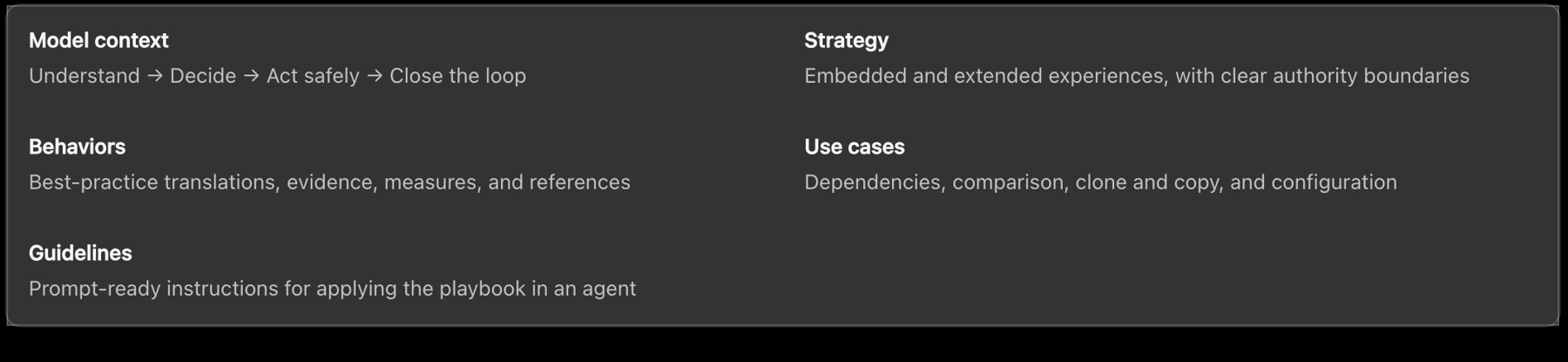
I packaged the playbook as a portable skill so teams can bring the strategy into AI-assisted design and engineering workflows. The site presents it as a downloadable SKILL.md containing the shared model, strategy, behaviors, use cases, references, and agent guidelines.
It is intended to support alignment before design, critique during development, and checks of handoff, recovery, traceability, and the result before launch. The packaging is my work; the included shared guidelines retain my colleague’s authorship.
This is a resource I’m developing and working with teams to adopt. As we begin supporting edit capabilities, Yankun Wang is reviewing audit logging. Adoption and audit design are ongoing; their effect on delivery has not yet been measured.
The work established a framework for moving beyond read-only AI while keeping enterprise administration understandable, governable, and traceable.
As the technology evolves, customer validation, executive reviews, and Cisco Live conversations continue to challenge assumptions and shape the direction.