Clarify the mental model
Explain who exposes capabilities, who consumes them, and where an app will be used.
Leading AI configuration across developer and admin experiences, from CX settings to MCP, A2A, bring-your-own-LLM, and reusable authentication.
Agentic Apps Lead / previously CX Lead Admin Designer
Developer Portal / App Hub / Control Hub
Ongoing strategy and design / navigation change merged
I lead Agentic Apps design across Developer Portal, App Hub, and Collaboration Control Hub.
The journey spans developer registration, app discovery and distribution, and administrator configuration and governance. My work includes MCP, agent-to-agent (A2A), and bring-your-own-LLM workflows.
I inherited the original MCP experience rather than designing it from scratch. My contribution is leading its evolution, grounding improvements in research, and helping introduce shared authentication across capability types and surfaces.
An April 2026 study with four participants examined the end-to-end Developer Portal and Control Hub experience.
Three of four participants struggled with the MCP/A2A choice and connection direction. They wanted guidance based on what they were trying to accomplish. All four questioned the role of secrets in Control Hub.
Explain who exposes capabilities, who consumes them, and where an app will be used.
Help admins understand scope, permissions, changes, and the handoff from registration to approval.
These are directional findings from a small qualitative study, rather than population-level measures.
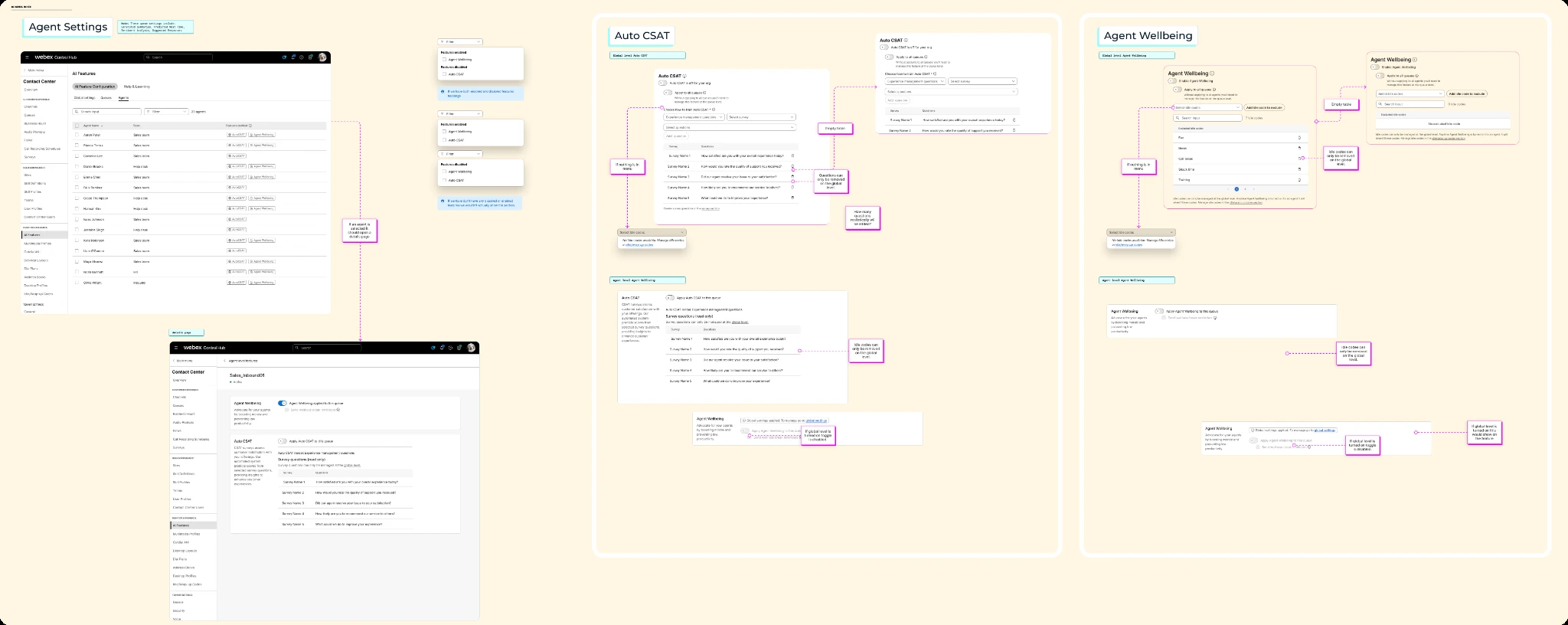
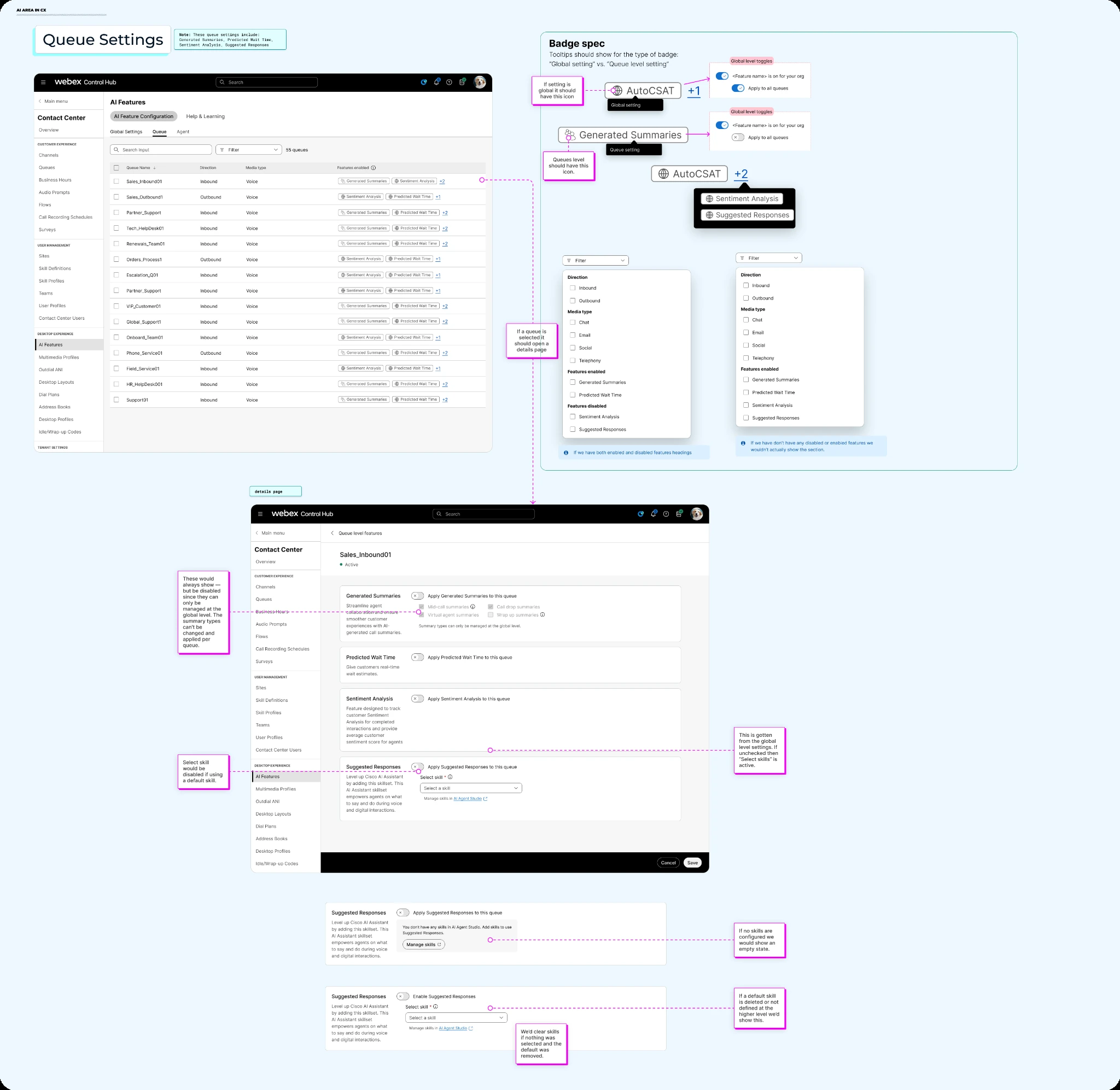
As Lead UX Manager for CX, I led two designers and advocated for a dedicated AI management area that brought settings together.
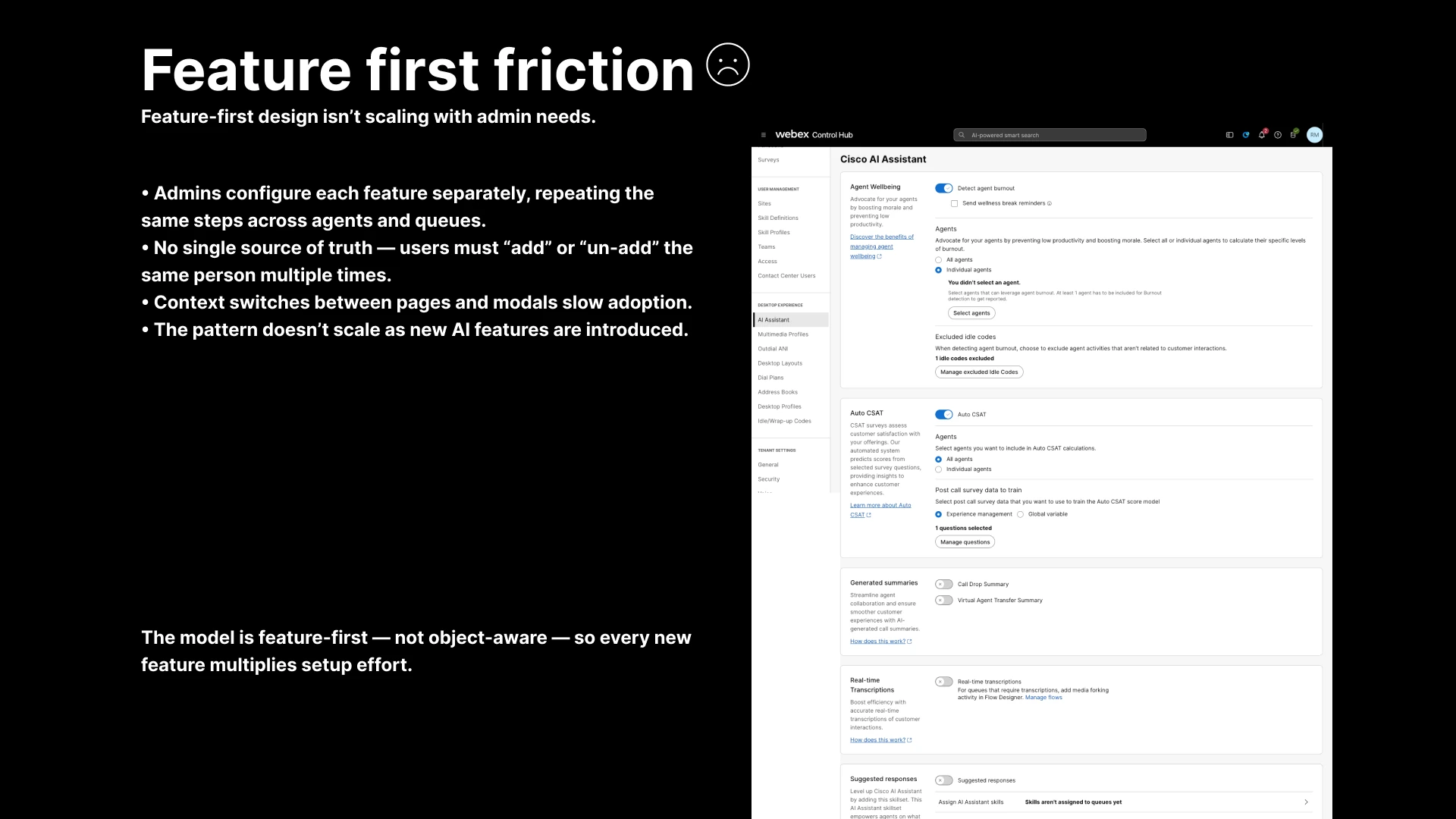
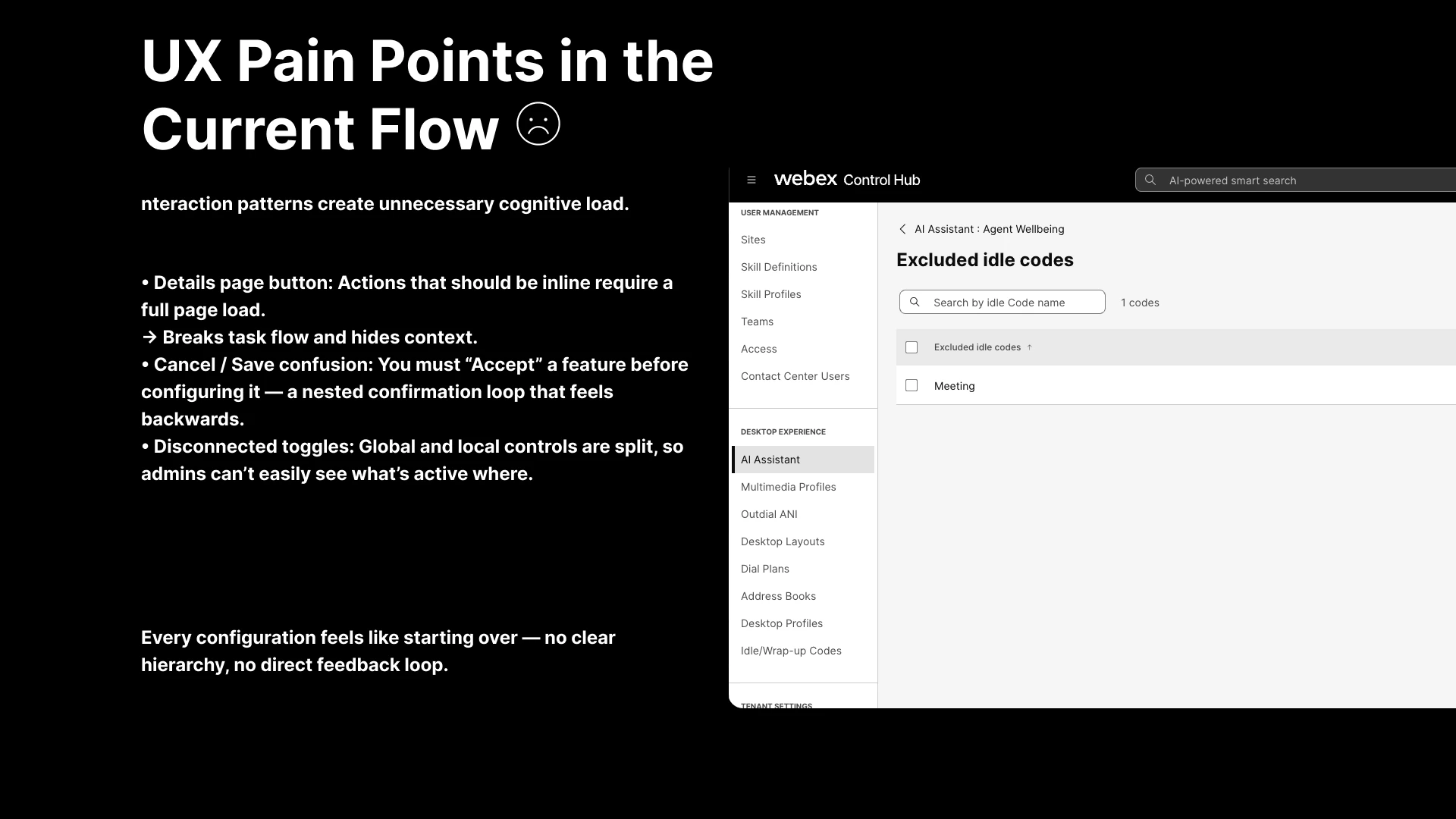
The existing model repeated setup across agents and queues, separated global and local controls, and interrupted tasks with page and modal transitions.
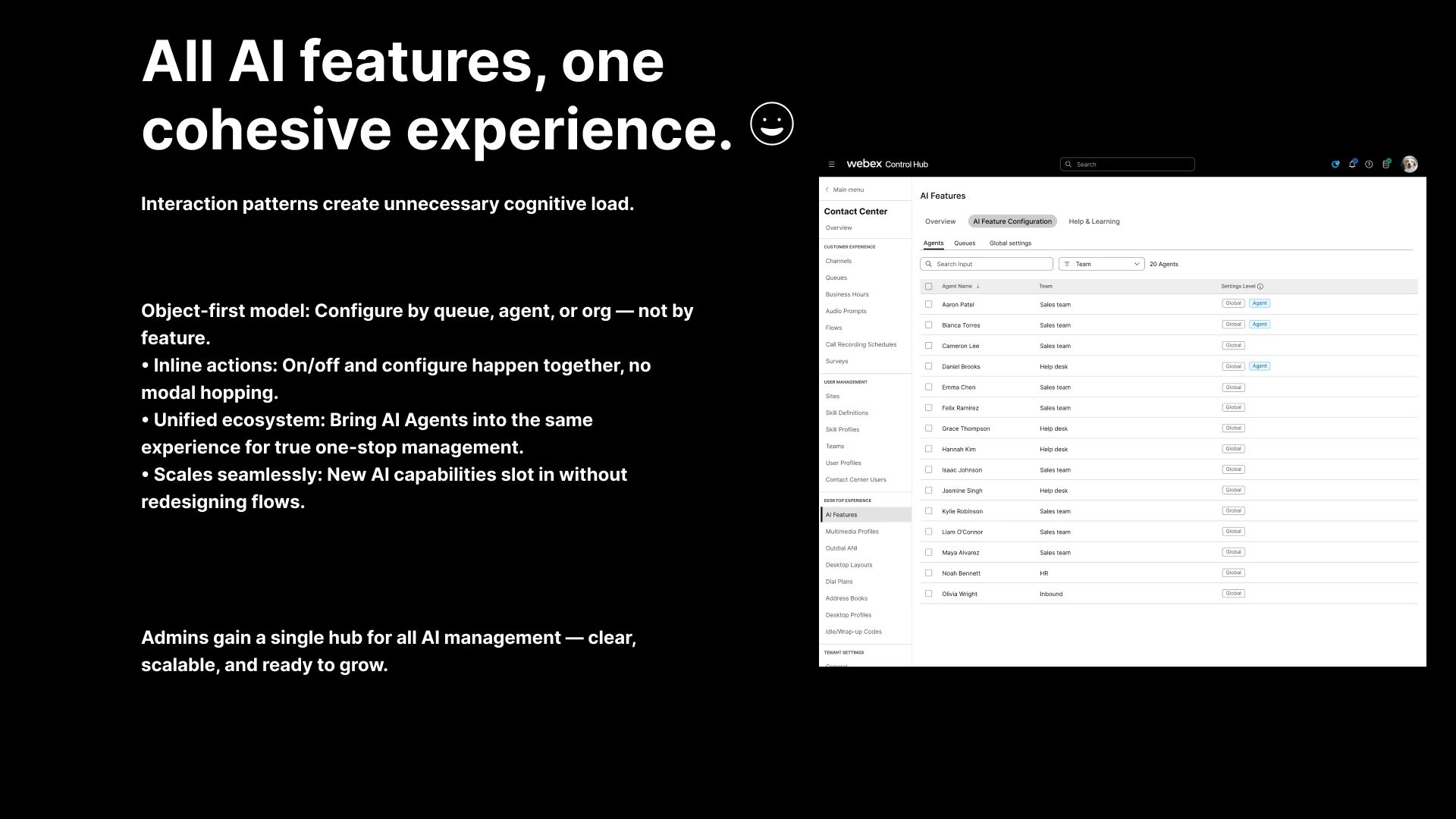
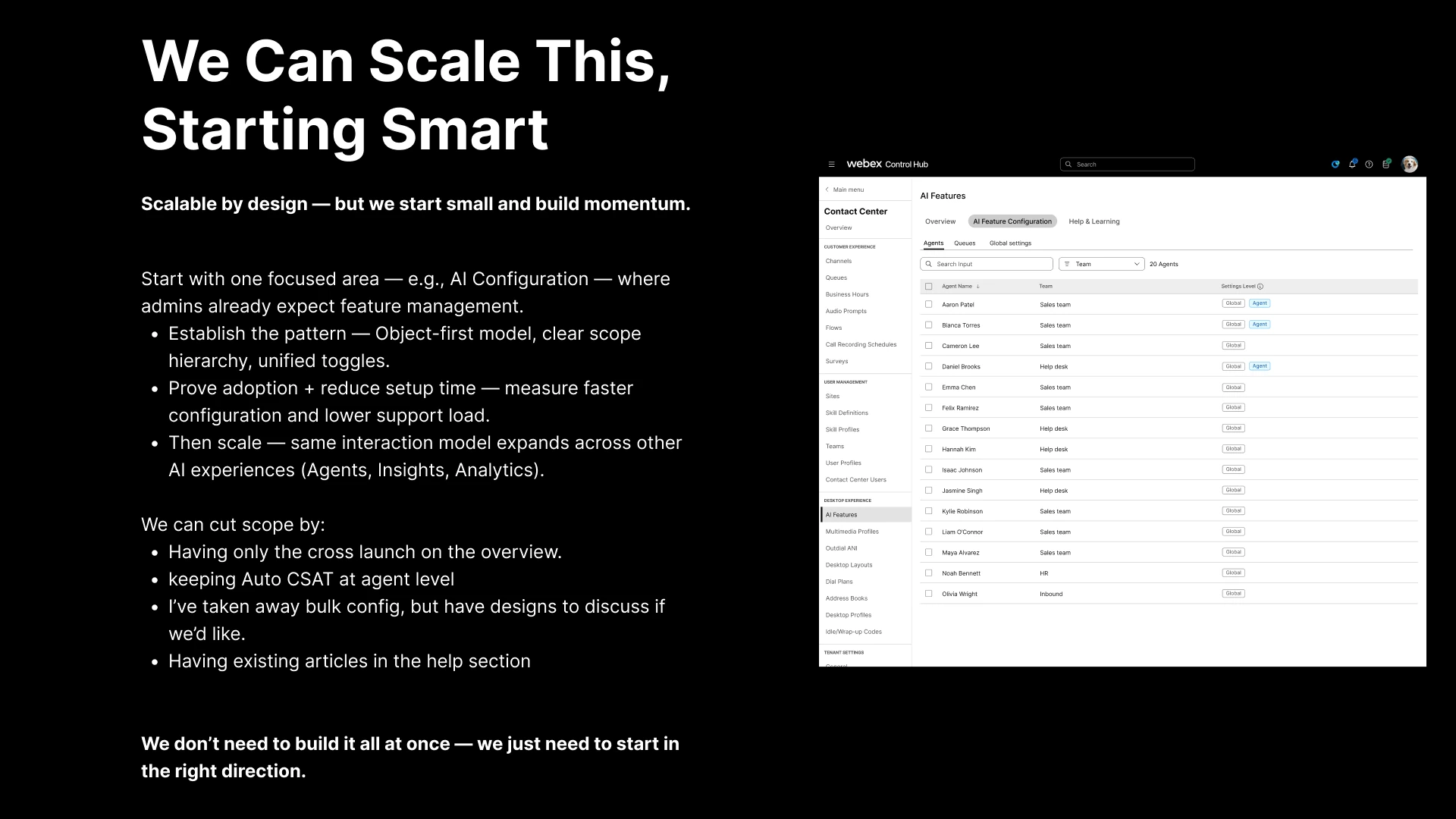
I proposed organizing configuration around agents, queues, and global settings. The design makes scope visible, groups relevant capabilities, and connects feature controls with configuration.
Stakeholders questioned whether bringing AI features into one section would make a meaningful difference. I advocated for the unified area and the team’s design direction. We also included help content so customers could understand features before enabling them.
When we showed the unified experience to customers, they expressed enthusiasm about using it. That response supported the direction, but it does not yet establish a measured improvement in adoption or configuration time. Quantitative follow-up is pending.
I also led UX design for CX AI routing, part of my CX AI work.
One customer reported a 30% reduction in call duration.
Another customer reported an average reduction of 27 seconds per AI-routed call across 2,198 calls.
These are separate customer-reported results for AI routing. They describe the product outcome, rather than isolating the effect of UX design, and do not measure the unified AI settings experience described above.
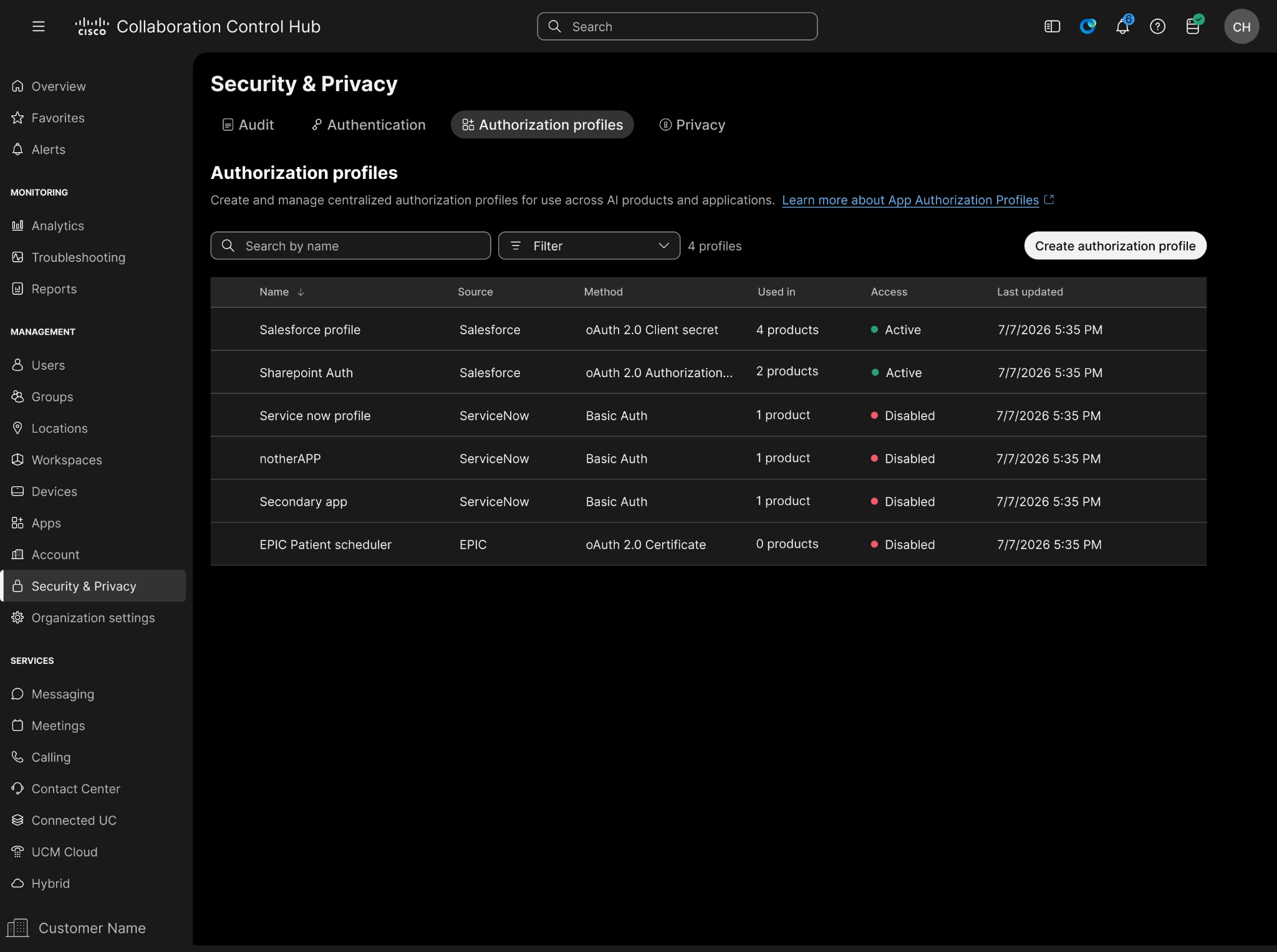
I helped introduce a central area for reusable authentication profiles across AI capabilities, surfaces, and types.
The current design labels this area Authorization profiles, within Security & Privacy. It brings profile source, method, usage, and access status into one management view.
The goal is to separate managing a reusable profile from repeatedly configuring credentials within individual AI app workflows. This shared experience is in development.
I’m shaping a broader Agentic Apps direction: an AI management area in Control Hub that supports understanding, configuration, governance, and adoption.
The CX work provides a related pattern: give AI capabilities a coherent home while retaining the context and scope admins need. This is a product direction in progress, rather than a claim of delivered adoption gains.
I also implemented a navigation change moving Agentic Apps earlier in the Apps tab order and took it through merge. See the code contributions
The Agentic Apps experience we’ve created serves 172 daily active admins configuring and managing their agentic apps.
Webex MCP daily active users increased from 108 on July 1 to 931 on September 15. Monthly users rose from approximately 13,000 in July to 14,000 in August, reaching 15,000 through September 26.
This growing use reinforces the need for clear configuration, reusable authentication, and governance. These figures describe platform reach and adoption; they do not establish growth caused by my design work.
Two reported snapshots
Monthly user trend · approximate counts
Next measures to establish: configuration completion rate and time, successful reuse of profiles across apps, and discovery-to-configuration progression. These are proposed measures, not reported results.